

UK Spray Foam Insulation Removal Specialists Trusted By Lenders, Surveyors And Homeowners
Your valuation came back against you because of the foam. We take it out by hand, back to clean timber, and give you the certification your lender asks for.




Why Spray Foam Insulation Becomes A Problem
Foam looks like a quick insulation fix until a lender, a surveyor or a buyer asks what is underneath it. Here is what tends to go wrong, and why.
Blocked ventilation, hidden rot
Foam seals the roof space and stops air moving through it. Moisture builds against the timber instead of drying out, and the rafters rot from the inside where nobody can see them.
A concealed structure, a valuation marked down
Foam covers the timber, so nothing about its condition can be checked at survey. Lenders do not just delay a decision on cover they cannot see, several knock money off the valuation to price in the risk instead.
A widespread problem, a narrow buying pool
The Property Care Association estimates around 250,000 UK homes carry spray foam in the loft. Every one of those owners meets the same wall when they try to sell or remortgage.
Trapped moisture, growing mould
Stagnant air under the foam holds moisture close to the timber and the felt. Mould takes hold in the loft long before anyone smells it from the rooms below.
What Removal Actually Sets Right
Taking the foam out is the first step, not the whole job. Here is what else needs sorting once it is gone, and why.
Mortgage and survey preparation
A RICS surveyor can request an independent specialist report on a property that has carried spray foam, even after removal. We photograph the roof before, during and after the work and log moisture readings throughout, so that report has evidence to work from.
Roof cleaning after removal
Foam removal leaves adhesive marks, dust and loose debris on the tiles and in the gutters. We wash the covering down by hand, clear the gutters and treat any moss we disturbed, so the roof looks finished once the scaffold comes down.
Roof timber inspection
With the timber exposed we check every rafter, purlin and joist for soft or discoloured wood, insect activity and water staining. You get photographs of what we found and what, if anything, needs treating or replacing before the roof goes back together.
Loft insulation replacement
Strip the foam out and the loft has no insulation left. Current Building Regulations target 270mm of mineral wool at ceiling level in two layers, or around 120 to 150mm if you use rigid PIR board instead. We fit whichever depth your loft needs.
Roof ventilation improvements
Foam seals the roof, which is the opposite of what BS 5250 asks for in a cold roof: ventilation equal to 25,000mm2 per metre at the eaves and 5,000mm2 at the ridge. We open that airflow back up, or build it as a warm roof, which needs no venting at all.
Safe disposal of the waste
Most household recycling centres will not take spray foam in bulk, and moving it yourself without a registered waste carrier licence is against the law. We bag every load, remove it under our own licence and give you the Waste Transfer Note as proof of where it went.
How We Remove Spray Foam, Start To Finish
Six stages, survey to certification, all done by hand and by machine, never by solvent or blowtorch. This is what happens once you book the job.
Survey and plan
We assess the property first: the foam type, how far it spreads and what it may be hiding. We agree the method and price before anything is cut, and take baseline photographs so the mortgage or survey paperwork has a clear before-and-after record.
Protect and contain
Before any cutting starts we seal off the work area and protect the ceilings, floors and rooms below from dust. Open-cell in particular sheds fine debris the moment it is disturbed, so containment goes up before the first cut, not after.
Strip the bulk foam
The bulk of the foam comes off first, worked back mechanically to within a few millimetres of the timber. This is the stage that clears most of the material and most of the weight, and it sets up the careful hand-finishing that follows.
Hand-finish and extract
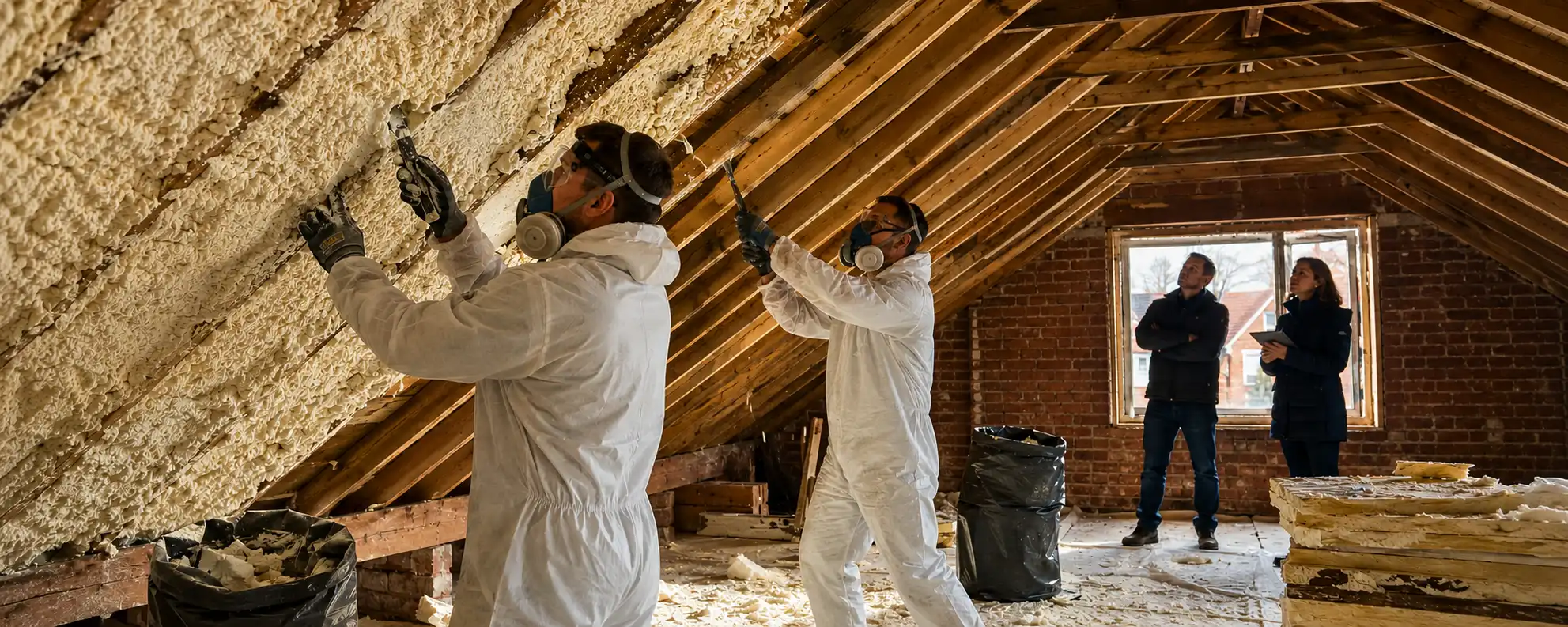
What is left after the bulk strip gets worked off the timber grain by hand, using chisels and scrapers rather than solvents or heat. Vacuum extraction draws the loose foam and dust out of the roof space as we go, instead of carrying it down through the house in bags.
Inspect and treat the timber
With the timber bare we check every rafter, purlin and joist for soft or discoloured wood, insect activity and water staining. Anything that needs treating or replacing gets dealt with at this stage, before the roof or loft goes back together.
Reinstate, dispose and certify
Ventilation, insulation or roof covering go back to current standards where the job calls for it. All the waste leaves site under our own waste carrier licence, and you get the Waste Transfer Note along with the photographs and moisture readings for your records.
Why Homeowners Across Hampshire Choose JSA
JSA combines specialist spray foam removal with extensive roofing knowledge to deliver safe, professional results. From careful foam extraction and roof timber inspections to repairs and ventilation improvements, we provide a complete service backed by honest advice, transparent pricing and quality workmanship.

15+ Years of Roofing Expertise
Our experienced roofing team understands the structure beneath your spray foam insulation, allowing us to remove it safely while protecting roof timbers, tiles and other essential components.

Specialist Spray Foam Removal
With five years dedicated to spray foam insulation removal, we safely remove both open-cell and closed-cell foam using proven techniques that minimise disruption and help preserve your roof's condition.

Honest Advice & Transparent Pricing
We believe in straightforward recommendations, competitive pricing and no hidden costs. Every quotation is clear, with free, no-obligation advice to help you make the right decision for your property.
Trusted by Homeowners Across Hampshire
Read genuine customer reviews and see why homeowners and businesses trust JSA Spray Foam Removal for safe, professional workmanship. Visit our Checkatrade profile to discover honest feedback from customers who have experienced our reliable service and quality results firsthand.



Have Questions? We've Got the Answers
Find answers to the most common questions about spray foam insulation removal, roofing services, property surveys and our removal process. If you need further advice, our friendly team is always happy to help with free, no-obligation guidance.
Will removing spray foam insulation help me get a mortgage?
Removal on its own does not guarantee approval. What changes the outcome is evidence: a RICS surveyor can request an independent specialist report on a property that has carried spray foam, and that report is checked against photographs and moisture readings from the strip-out, not a verbal assurance that the foam is gone.
How do you remove spray foam insulation?
By hand and by machine, never by solvent or blowtorch. The bulk comes off first, worked back mechanically to close to the timber, then the residue is taken off the grain with chisels and scrapers while a vacuum extracts the loose material and dust as we go.
How long does spray foam removal take?
Most UK jobs run 2 to 5 working days, depending on the size of the loft or roof, how much foam is there and how easy the space is to access. A small loft with a thin layer of open-cell foam sits at the short end of that range, a detached roof bonded in closed-cell sits at the long end.
What happens to the insulation after the foam is removed?
Nothing is left behind. Foam removal takes the loft back to bare joists with no insulation at all, so most jobs need it replacing to the current Building Regulations target of 270mm of mineral wool, or 120 to 150mm of rigid PIR board, whichever suits the loft.
Is spray foam removal waste hazardous, and how is it disposed of?
Most household recycling centres will not take it in bulk regardless of classification, and moving it yourself without a registered waste carrier licence is against the law. We remove it under our own licence and issue a Waste Transfer Note as proof of where it went.
Will spray foam insulation stop me selling my house?
It can. The Property Care Association estimates around 250,000 UK homes carry spray foam in the loft, and most mainstream lenders will not approve a mortgage on a property where a surveyor cannot inspect the timber underneath it. Removing the foam and documenting the work is what gets a sale moving again.
Professional Spray Foam Removal Across Hampshire
JSA Spray Foam Removal proudly serves homeowners and commercial properties throughout Hampshire and the surrounding areas, delivering trusted spray foam removal, roofing services and free, no-obligation quotations wherever you need us.

Let's Work Together
Need a Roofer You Can Rely On?
From a slipped tile to a full re-roof, JSA Roofing Solutions gives you honest advice, quality workmanship and more than 15 years of experience across Hampshire. Get in touch for a free, no-obligation quotation and clear written costs before any work begins on your roof.


8:00 AM – 6:00 PM
Saturday & Sunday
Closed